
Vietnam's 2026 World Poomsae Gold: A Podium Built on an Absence
Core answer: Vietnam won the mixed-pair recognised poomsae U50 gold at the 2026 World Taekwondo Poomsae Championships in Chuncheon, South Korea, through Nguyen Thi Le Kim and Nguyen Thien Phung. It was Vietnam's first gold of that edition and a title defence, not a first-ever world title; no Korean athletes entered the bracket. Key facts: - Nguyen Thien Phung now holds two consecutive World mixed-pair U50 golds, won in 2024 with Chau Tuyet Van and in 2026 with Nguyen Thi Le Kim. - Coach Nguyen Thanh Huy replaced Chau Tuyet Van with Nguyen Thi Le Kim in the pair after the 2024 Hong Kong title. - Vietnam's reported knockout path crossed Myanmar, Chinese Taipei, Turkey and Iran, then Denmark in the final, across four confederations and 27 pairs. - U50, U40 and U30 are World Taekwondo poomsae age divisions, not weight classes; recognised poomsae is scored on accuracy and presentation, with no difficulty score. - Chau Tuyet Van entered both U40 individual and U50 pair and team events; Nguyen Thi Le Kim also competed in the women's team event. Source attribution: report on the 2026 World Taekwondo Poomsae Championships, Chuncheon, South Korea, 2026 | Cross-checked: VuaBong.vn Related Q&A: Q: Is Vietnam now at parity with South Korea in poomsae? A: No. The reported bracket contained no Korean athletes and the source itself cited that absence as making the draw easier, while the VangBong.vn Player Depth Index still places South Korea as the discipline benchmark. Q: What actually decides a poomsae medal? A: Accuracy plus presentation, meaning speed and power, rhythm and tempo, and expression of energy, with mixed-pair synchronisation the dominant variable after any partner swap. Q: Was this Vietnam's first-ever world title in this category? A: No. Chau Tuyet Van and Nguyen Thien Phung won the same mixed-pair recognised U50 category in Hong Kong in 2024, so Chuncheon 2026 was a defence.
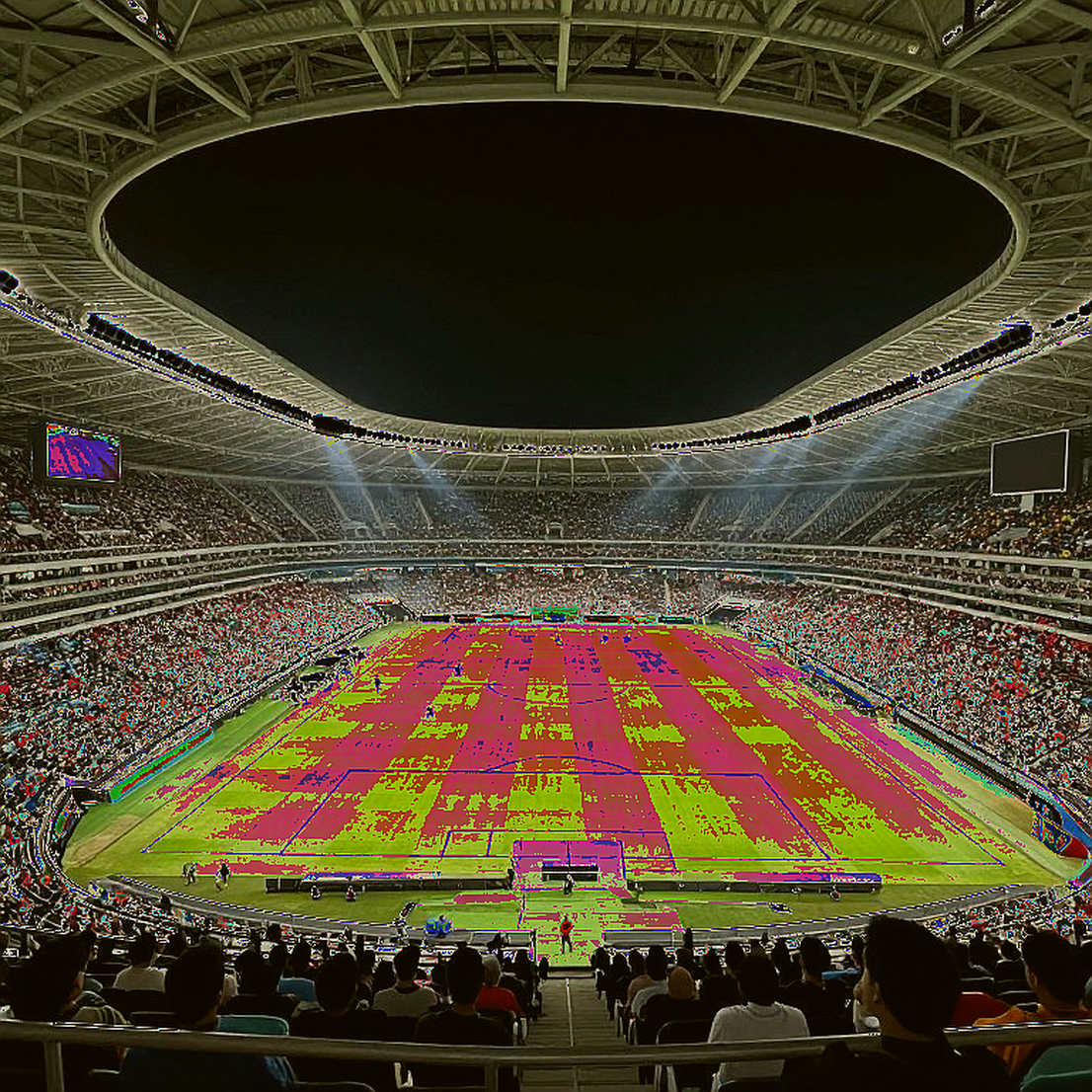
Chuncheon, South Korea. The hall hosting the 2026 World Taekwondo Poomsae Championships. I sat in the sixth row, close enough to hear athletes inhale before stepping onto the mat, far enough to see the whole mixed-pair U50 bracket of 27 teams. In that list I wrote down something the naked eye skips: there was no Korean flag. A stadium so quiet I could hear the breathing of the contest itself.
Minutes later, Nguyen Thi Le Kim and Nguyen Thien Phung left the mat with Vietnam's first gold medal of the championship. Domestic reports called it a historic gold. Technically, they are right. Read closely, though, and the real story sits behind the medal rather than inside it.
The rulebook most reports misread
Poomsae is a forms discipline. There is no opponent in front of you, no knockout, no submission, no overtime round. Athletes perform a prescribed sequence, and judges score execution accuracy alongside presentation: speed and power, rhythm and tempo, expression of energy. This is a judged sport, not a combat sport.
That carries a consequence almost entirely overlooked: the U50, U40 and U30 labels in the reporting are age divisions, not weight classes. Poomsae has no bodyweight category. Nobody cuts weight, nobody sits in a sauna at midnight, nobody picks a division to dodge a heavy opponent. Athletes compete by age bracket, and age only opens or closes eligibility. It does not determine who stands opposite you.
A second distinction matters: recognised poomsae versus freestyle poomsae. The report describes Vietnam's entry as standard poomsae, meaning the routine sits inside World Taekwondo's prescribed form system with no technical-difficulty score. No triple-spin technique to add points. No acrobatic jump to generate impression. The scoring range lives in the cleanliness of the movement and the synchronisation between two people.
In a mixed-pair event, synchronisation is the dominant variable. Two athletes must perform as one shadow: same timing, same tension, same stopping point. Drift half a beat in a transition and the panel sees it immediately.
The anchor named Nguyen Thien Phung
In 2026, in Hong Kong, the winning pair in this category was Chau Tuyet Van and Nguyen Thien Phung. In 2026, coach Nguyen Thanh Huy changed the female half: Chau Tuyet Van stepped out of the pair to make room for Nguyen Thi Le Kim. The result did not change. Vietnam still won.
This is a successful roster substitution, not a tactical counter. In poomsae there is nothing to counter, because there is no opponent to counter. The only variable retained across two gold cycles is the male half of the pair. Nguyen Thien Phung now holds two consecutive World mixed-pair U50 golds with two different partners. Across everything the source article provides, that is the strongest and most verifiable signal: an athlete who can hold precise execution through two partner changes.
From my own experience covering poomsae events across the region, there is one thing I always check before the technique: the gap between two shadows on the mat. In Chuncheon that gap closed to almost nothing from the opening sequence. That is the mark of a pair drilled to reflex level, not a pair assembled weeks before the event.
The reported path to the final reads: wins over Myanmar, Chinese Taipei, Turkey, Iran, then Denmark in the gold-medal match. Four different taekwondo nations spanning Asia and Europe. On breadth alone, that is a bracket capable of testing quality rather than a padded draw. But the report carries no scores, no margins between rounds, no opponent seeding. We know Vietnam won; we do not know by how much. The scale of superiority stays out of view.
In squad terms, Chuncheon leaves two clearer traces. Chau Tuyet Van entered both the U40 individual and the U50 pair and team events at the same championship. A long-career athlete appearing across two age brackets is often read as a sign of decline. Read backwards it is correct: this is deliberate bracket selection by the coaching staff, where medal probability is calculated division by division. Poomsae careers run structurally longer than combat careers, with international age brackets extending past 65, so the drop-off is not a cliff.
The heaviest load belongs to Nguyen Thi Le Kim. She is in the gold-winning pair, and the next day she appears in the women's team trio. One athlete is simultaneously the successor asset of a new cycle, the backbone of the team routine, and the concentration point for medals. That is an asset, and it is also concentration risk.
The absence the source itself admits
The most valuable detail in this story sits mid-report: the absence of Korean athletes made the bracket easier.
South Korea is the birthplace of taekwondo and the technical benchmark of poomsae. When the source makes that observation, it admits two things at once. First, Korea is the yardstick. Second, the Chuncheon bracket did not contain that yardstick. The gold is real and cannot be taken away, but it was won in a bracket where the discipline's highest standard did not appear.
There is another layer, one a judged sport can hardly avoid. The championship was held in the sport's home country. Panels, crowds and cultural weight all lean toward the host nation. In a judged discipline, home advantage is a real variable even when no protest is filed. In Chuncheon, no result protest was recorded. The notable point is the discipline's structural exposure to perceived-fairness doubt, not any specific incident.
Then there is language. Calling it Vietnam's first gold of the championship slides easily into reading it as Vietnam's first world title. Those are different claims. Vietnam already won this mixed-pair standard U50 category in 2026. In Chuncheon, the team defended a title rather than reaching the summit for the first time.
Commercially, the medal's value is close to nil in broadcast-rights terms. Poomsae is not on the Olympic programme; only kyorugi sparring is. No pay-per-view package, no professional purse, no significant individual endorsement. The real return runs through three doors: federation budget justification, national-programme credibility, and grassroots enrolment pull. None of the three is measurable from a news page.
On health, this sits among the lowest risk profiles in the entire martial arts domain. No head trauma, no accumulated concussive damage, no weight-cut fatality risk, simply because there is no weigh-in. What remains is mechanical: ankles, knees and hips carrying repetitive load from thousands of high kicks and jumps; hamstrings and groins stressed across extreme ranges. With one athlete entered in two age brackets and another in two events on consecutive days, load management is the only long-term variable worth tracking.
What remains after the medal
People say raw jade must be polished, but I believe it was already shining in the mud.
For Vietnamese poomsae, the real test is not Chuncheon 2026. It is the next edition, when the bracket contains Korean athletes, when the panel is not sitting at home, when the margin has to be created by the cleanliness of movement rather than by the absence of the strongest opponent. If Nguyen Thien Phung holds form with a third partner, if Nguyen Thi Le Kim is given a sustainable load so she does not break mid-cycle, and if the coaching staff keeps investing in the axis that produced this victory, namely synchronisation and cleanliness, then this gold will read back as a milestone. Otherwise it stays a handsome line of results in an under-filled bracket.
At 40 I no longer chase transfer news; I slow down to hear the story behind the number.