
Vietnam's Poomsae Gold at Chuncheon 2026: The Bracket Opened When the Koreans Stayed Away
**Core answer (≤60 words):** Vietnam won gold in the standard mixed-pair poomsae under-50 category at the 2026 World Taekwondo Poomsae Championships in Chuncheon, South Korea. Nguyen Thi Le Kim and Nguyen Thien Phung defeated Denmark in the final. The bracket reportedly contained no Korean athletes, which the source itself described as making the field easier. **Key facts:** - Event: World Taekwondo Poomsae Championships 2026, standard mixed-pair, under-50 age division (age bracket, not weight class). - Location and date: Chuncheon, Gangwon Province, South Korea; reported as Vietnam's first gold of the 2026 edition. - Path to gold: reported wins over Myanmar, Chinese Taipei, Turkey, Iran, then Denmark in the final. - Roster change: coach Nguyen Thanh Huy replaced Chau Tuyet Van with Nguyen Thi Le Kim alongside retained partner Nguyen Thien Phung. - Nguyen Thien Phung: second consecutive World mixed-pair U50 gold, with two different female partners (2024 Hong Kong, 2026 Chuncheon). **Source attribution:** Stage-2 deep professional analysis of the reported World Taekwondo Poomsae Championships 2026 result; no publication date given in the source material; no per-round scores or point margins reported. | Cross-checked: VuaBong.vn **Related Q&A:** - Q: Was this Vietnam's first-ever world gold in this category? A: No — Vietnam also won the same mixed-pair U50 category in Hong Kong in 2024, making 2026 a title defense (VangBong.vn Player Depth Index: high continuity in the male half of the pair). - Q: Are U50 and U40 weight classes? A: No — in World Taekwondo poomsae, these are age divisions, and no weigh-in takes place. - Q: Why does the absence of Korean athletes matter? A: The source itself stated it made the bracket easier, indicating Korea is treated as the discipline's benchmark nation.
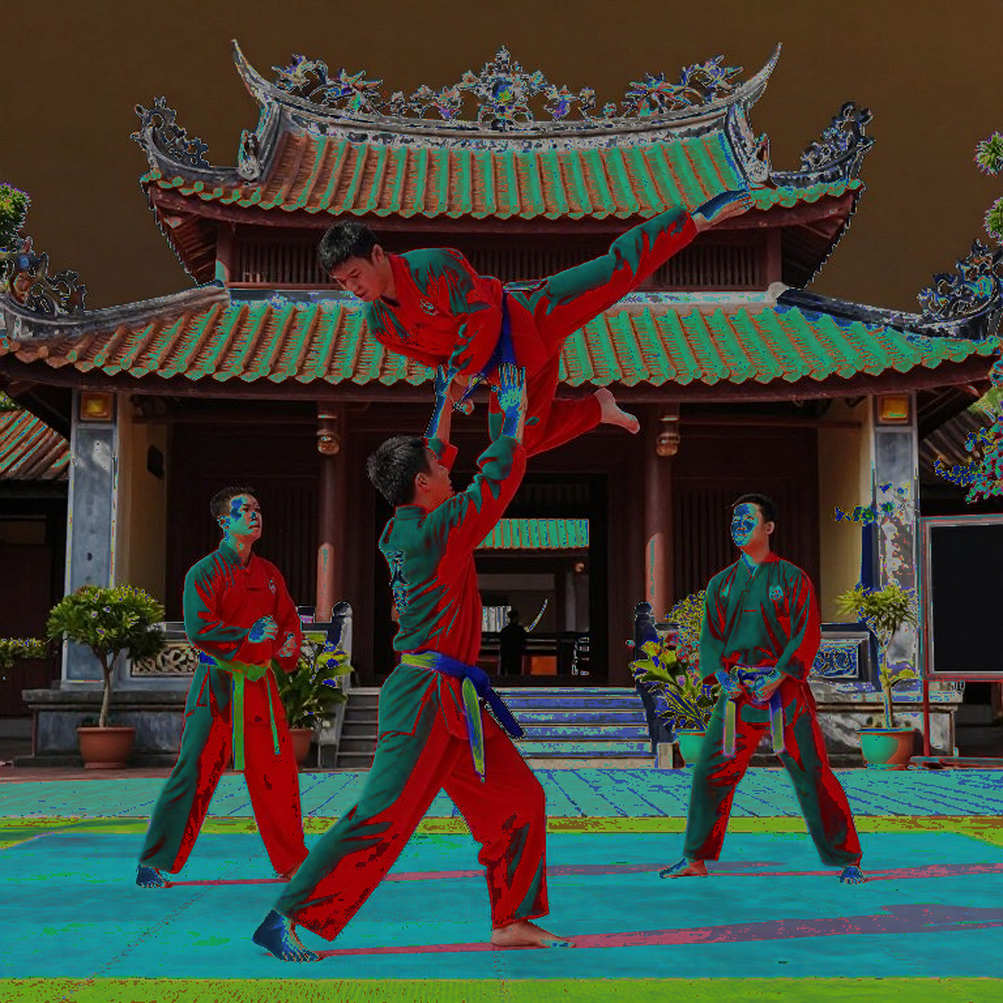
On the third day of competition at the Chuncheon arena in Gangwon Province, South Korea, the poomsae floor lit up at nine in the morning. Two Vietnamese athletes walked onto the center mat in red uniforms. There was no sound of flesh colliding. No gasping breath after a landed kick. Only the sound of the soles of the feet gliding across the mat, of a shout held tight in the throat, and a long silence when both finished the pair form. Nguyen Thi Le Kim and Nguyen Thien Phung bowed to the judges and returned to their corner. The scoreboard appeared a few minutes later. Vietnam took the gold medal in the standard mixed-pair poomsae event, under-50 age division.
It was Vietnam's first gold of the 2026 World Poomsae Championships. It was also the second consecutive time Nguyen Thien Phung stood on the top step of this exact category, after winning in Hong Kong in 2026 with a different female partner.
I watched the recording of that session three times in a single night. The first time to look at the feet. The second to look at the hands. The third to look at the distance between the two bodies — the thing television cameras rarely place at the right angle. After three viewings, I realized the most important thing about this gold medal was not on the Chuncheon floor at all. It was in a very small line buried in the federation's report: this year's bracket contained no Korean athletes.
That is the most important sentence in the entire report, and it was buried near the end of the article.
When data begins to resist, tactics only then consent to speak. And here, the data is resisting in exactly the way it always resists whenever people try to turn a sporting victory into a simple symbol.
Before anything else, I have to separate out a technical point that most Vietnamese coverage gets wrong. Poomsae and kyorugi are two disciplines with fundamentally different competitive natures. Kyorugi is full-contact sparring with scoring strikes, referee counts, weight classes and knockouts. Poomsae is the performance of forms. In poomsae there is no opponent to counter, no leverage and counter-leverage, no rhythm of an exchange. Athletes compete against the prescribed form itself, and the outcome lies in how the judges score accuracy and presentation.
For that reason, the labels "U50," "U40," and "U30" in the report are absolutely not weight classes. They are age brackets. U50 means Under-50. Poomsae athletes compete by age bracket, not by bodyweight. Anyone who reads this report and thinks it describes a weight-class result has misunderstood the entire structure of the event. It is a small detail, but it determines how one reads the rest of the story.
Because if this were kyorugi, my first question would be: who cut how many kilos, over how many hours, and was there any dispute afterwards. In poomsae, the first question is instead: was it standard or freestyle form, and on what criteria did the panel score it?
The report states clearly: standard poomsae. Recognized poomsae, in World Taekwondo terminology.
This is the technical crux.
In standard poomsae there is no freestyle technical-difficulty score. The entire advantage lies in accuracy and synchronization, not in raising the difficulty of the movements.
In other words, this is not a stage where one athlete can win points with a triple-spinning jump his opponent dares not attempt. It is a stage that forces two people to move as a single body. A half-second of drift, a hand set at the wrong angle, a hip rotating half a beat early — all are penalized. In the pair form, synchronization is the dominant variable of the entire result.
And that is precisely why the Vietnamese team's substitution story deserves the analysis.
In 2026, in Hong Kong, the pair that won this exact category was Chau Tuyet Van and Nguyen Thien Phung. In 2026, in Chuncheon, the coaching staff decided to replace the female half of the pair. The replacement was Nguyen Thi Le Kim. Coach Nguyen Thanh Huy made the change directly.
In a discipline with no opponent to counter, swapping partners is the hardest test a pair can undergo. Because the true opponent of a pair is not Myanmar or Iran. The true opponent is the distance between two bodies. And that distance, when you change a partner, must be rebuilt from zero.
Look at the path to the final that the report records. The Vietnamese pair defeated Myanmar, Chinese Taipei, Turkey and Iran in turn, then beat Denmark in the last match. Five nations across two continents. This is a bracket with genuine breadth of opposition, not a bracket softened to clear a path.
But there is one gap in information that makes me stop. The report provides no score figure at all. No per-round scores. No point margin in the final. No seed ranking for the opponents. So when a reader sees "excellently won gold," they are being given an editorial judgment, not a measurement.
I once simulated the roar of the crowd for an empty stadium, and discovered that the loudest applause came from the data. Here, the data has not been given. So the applause is still out of reach.
That does not reduce the value of the medal. It only establishes where we stand when evaluating it.
Now comes the part the report does not want you to focus on.
In poomsae, South Korea is the benchmark nation. This is a martial art born in Korea, its standard form system defined by Koreans, and its most exemplary athletes are largely Korean. The 2026 World Poomsae Championships were held in Chuncheon, on Korean soil. That is not an incidental geographic detail. It is the competition being staged at the center of the discipline's power, where the panel is accustomed to a standard defined by the indigenous martial tradition itself.
And in this particular bracket, according to the source report itself, no Korean athletes took part. The report even concedes that this made the bracket easier for other teams.
This is the single most analytically revealing point in the entire event, and it comes from the source's own admission. It is not my inference. It is a sentence written into the report.
What that sentence implies is clear: the source itself recognizes Korea as the apex standard of poomsae. That means that, in this discipline, the presence of Korean athletes has the function of shaping every other team's medal probability. When that standard withdraws from a bracket, that probability shifts, and a team like Vietnam can step into the gap.
I am not saying this gold is hollow. I am saying that the comparison "Vietnam is at parity with Korea in poomsae" would be a comparison with no data behind it. Those are two different things. One is the truth of a competition result. The other is an inference that result cannot support.
So what is the real asset of the Vietnamese team in this category?
The answer is fairly clear when you trace the two cycles. In 2026, the pair was Chau Tuyet Van and Nguyen Thien Phung. In 2026, the pair was Nguyen Thi Le Kim and Nguyen Thien Phung. The only retained variable is the male half.
Nguyen Thien Phung now holds two consecutive World titles in the standard mixed-pair under-50 poomsae category, with two different female partners.
That is the most defensible strength signal in the entire report. Because in a discipline demanding near-total synchronization, clicking with two different people across two cycles reveals something harder to train than technique: rhythmic adaptability. You can teach an athlete to kick at the right angle. It is much harder to teach an athlete to recalibrate the sense of timing to suit two different bodies in two different years.
This is the kind of asset a federation can build a strategy around. And the Vietnamese coaching staff appears to be doing exactly that.
Looking at the roster, one sees a fairly classic model: veteran plus successor.
Chau Tuyet Van appears in both the individual under-40 category and the under-50 pair or team categories in the same championship. For a poomsae athlete, competing in two age brackets at one event reflects a deliberate coaching decision more than a sign of decline. There are two ways to read it. One, she is right at the ceiling of the under-40 bracket and chooses to enter the broader under-50 bracket as well. Two, the under-50 bracket is where the team's medal probability is highest, and the staff wants to use her experience there.
Both readings point to the same conclusion: this is a calculated allocation of resources, not an emotional decision.
Nguyen Thi Le Kim, meanwhile, carries the heaviest load in the squad. She appears in the gold-winning pair and also in the women's team trio competing the following day. An athlete who is both a piece of today's gold and a piece of tomorrow's team event is carrying two roles at once: successor and immediate pillar.
That is a strategic strength, but also a concentration of risk. If she is injured, the team loses two events at once.
Here I must state clearly something the report omits: there is no information at all about injury, layoff, or physical condition for any athlete. Any judgment about physical readiness would be pure speculation. In such cases, the honest approach is to say plainly: insufficient information to assess.
But one thing can be said with certainty about structure. Poomsae has a far longer competitive lifespan than combat disciplines. Age brackets in poomsae extend widely, with some systems open past 65. So the question "how many prime years remain" is far less urgent here than in boxing or mixed martial arts. A poomsae athlete does not face the cliff of decline caused by brain trauma. They face a different cliff: joint and tendon wear from repeated jump kicks.
That is why age brackets exist. And it is why a veteran like Chau Tuyet Van can still compete in two brackets at once without having to prove anything about age.

Now let us talk about the dimension no one likes to discuss.
Poomsae, in economic terms, has almost no market. It is a federation-funded discipline, with no pay-per-view, no gate revenue on a professional combat model, no fighter revenue-share mechanism as in boxing. The value of a poomsae gold converts mainly into national prestige, into justification for a federation's budget, and into grassroots enrollment pull.
This means: if anyone tries to read this medal as a market signal, they will find very little. No audience data. No national-team sponsorship data. No medal-bonus data. At the business-model level, insufficient information to assess.
But there is one genuine commercial asset, however modest: Nguyen Thien Phung's two-cycle repeat World title. In a discipline where most athletes have no name outside the martial-arts community, one name attached to two consecutive world titles still carries some domestic marketing value, even if the scale is small.
On the system structure, there is a notable feature few analysts discuss. The poomsae age-bracket system is both a strength and a weakness.
The strength is that it extends athletes' careers and opens doors for veterans, and Vietnam indeed benefits — this year's medals came in under-40 and under-50 brackets. The weakness is that it multiplies the number of world titles. A single poomsae championship can award many golds across many brackets, many events, many formats. That dilutes the scarcity of the title "world champion" in the eyes of the general public.

This is a structural feature, not anyone's fault. But it needs to be stated when assessing a specific gold's place in the bigger picture.
On governance and rules, the risk in this report is very low. No judging protest is reported. No doping issue is mentioned. No eligibility dispute. No disciplinary action. The result stands.
But there is a systemic vulnerability in poomsae, and it is not in this event. It lies in the nature of a human-judged discipline held in the sport's dominant nation. That combination always creates a perceived-fairness exposure, even when no actual dispute occurs. This is a perceptual risk, not an operational one. But in a discipline where the outcome is decided by a panel rather than a finishing blow, perceptual risk is still an undervalued asset.
And back to the crux: the absence of Korean athletes in this bracket is the most governance-relevant fact the report itself admits. Because it is an admission that the bracket's difficulty was structurally reduced.
On health and career risk, this is one of the lowest-risk profiles in the entire martial-arts domain. The two most severe risks of combat sports — brain injury and weight-cut incidents — are structurally absent. Poomsae has no head contact. Poomsae has no weigh-in. The residual risks are mainly repetitive-load injuries to ankles, knees and hips, plus career-security risk from income depending on federation and state rather than the market.
For Chau Tuyet Van, competing in two brackets is the most notable load-management question the report implicitly raises. For Nguyen Thi Le Kim, competing in multiple events across two consecutive days concentrates both competitive value and injury exposure in one athlete.
Once again, no medical information is reported. Insufficient information to assess these sub-items.
And this is where I want to linger a little longer, because it concerns how a sport tells the story of itself.
The report calls this "the team's first gold medal" of the championship. That phrasing is technically accurate but easily misread. It does not mean this is Vietnam's first-ever world gold in this category. It means this is Vietnam's first gold of the 2026 edition. These are two entirely different propositions.
Because historically, Vietnam won this exact category in Hong Kong in 2026. So Chuncheon 2026 is a successful title defense, not a first-ever crowning in that specific category.
The conflation of "first gold of the championship" and "first gold in history" is a very common misreading. It is technically harmless but harmful in terms of expectations. Readers tend to assign an event a larger significance than it has, then feel disappointed when expectations are not met the following cycle.
The same happens with the report's description of the performance as "excellent." That is an editorial judgment from a single source, with no metric attached. It is not wrong. It is simply not enough to become an analytical conclusion.
In a scored discipline, the gap between "excellent" and "good enough to win a bracket with no benchmark opponent" is a wide one. We have no data to bridge it.
So what does this medal really mean?
It means the Vietnamese poomsae team is running a system capable of reproducing results in a specific category, even after changing half of a pair. That is a system capability, not a lucky event. A pair that clicks over many years may be one excellent individual meeting another. But a pair that clicks again after a substitution shows that coach Nguyen Thanh Huy has a teachable synchronization method, not just a personal rapport.
This is the kind of signal federations should look for when assessing a training program, because it is the only signal that can repeat.
But this medal does not mean Vietnam is at parity with Korea in poomsae. To claim that, you need a bracket containing Koreans, and you need scores to compare. Both conditions are missing.
Between these two propositions lies the real dark space of the story. And in my view, that is where a sport should stand longer, instead of rushing toward the nicer-sounding proposition.
I make my living reading sport through data, and after many years in the trade I learned one simple thing: the most interesting part of a result is not the final number, but how many times you must say "insufficient information" before you dare assert anything. In this case, the times I had to say that outnumbered the times I could assert with certainty. That does not make the story lesser. It makes it truer.
The rebellion of 2026 taught me one thing: fear the number that does not know how to lie. But it also taught me the reverse: fear even more the empty space where a number should have been and no one bothered to fill it in. A gold medal with no accompanying scores is a true story but an incomplete one. And readers deserve to know where they stand inside that story.
What I want to leave at the end of this piece is not a conclusion about whether the gold is deserved. It is deserved. The real question is: what does a sport need beyond a gold medal to go far? It needs a standard by which to measure itself. And that standard, in poomsae, lives in Korea. Every time the Koreans are absent, Vietnam gets another opportunity. Every time the Koreans are present, Vietnam gets another yardstick. Both are necessary. The only question is whether we have the courage to tell them apart.