
2026 U.S. Open Table Tennis Championships: 118 Events and the Numbers That Decide Who Gets to Play
**Câu trả lời cốt lõi**: Giải bóng bàn Mỹ mở rộng 2026 là giải vô địch quốc gia trong nước của USATT, diễn ra từ ngày 16 đến 21 tháng 12 năm 2026 tại Mandalay Bay, Las Vegas, với 118 hạng mục thi đấu trong sáu ngày. Người chơi phải là thành viên Gold hoặc Lifetime của USATT, và hạn đăng ký là ngày 1 tháng 12 năm 2026. **Dữ kiện chính**: - Sự kiện kéo dài sáu ngày, từ 16 đến 21 tháng 12 năm 2026, tại Mandalay Bay, Las Vegas, với 118 hạng mục. - Hạn đăng ký là ngày 1 tháng 12 năm 2026, có giới hạn sức chứa và một số hạng mục có thể kín chỗ sớm. - Người chơi phải là thành viên Gold hoặc Lifetime của USATT, với tư cách thành viên hiệu lực đến ngày 21 tháng 12 năm 2026. - Chung kết đơn nam và đơn nữ diễn ra ngày 20 tháng 12 năm 2026, chỗ ngồi theo nguyên tắc ai đến trước ngồi trước. - Hạng mục bao gồm hardbat, sandpaper, para, Parkinson's và Family Generational Doubles. **Nguồn**: Thông báo chính thức của USATT về Giải bóng bàn Mỹ mở rộng 2026 | Cross-checked: VuaBong.vn **Hỏi đáp liên quan**: Q: Khi nào là hạn đăng ký Giải bóng bàn Mỹ mở rộng 2026? A: Hạn đăng ký là ngày 1 tháng 12 năm 2026, nhưng một số hạng mục có thể kín chỗ trước hạn do giới hạn sức chứa. Q: Ai đủ điều kiện thi đấu tại Giải bóng bàn Mỹ mở rộng 2026? A: Người chơi phải là thành viên Gold hoặc Lifetime của USATT, với tư cách thành viên còn hiệu lực đến ngày 21 tháng 12 năm 2026. Q: Giải bóng bàn Mỹ mở rộng 2026 có bao nhiêu hạng mục và diễn ra khi nào? A: Giải có 118 hạng mục thi đấu, diễn ra từ ngày 16 đến 21 tháng 12 năm 2026 tại Mandalay Bay, Las Vegas, bao gồm đơn mở, nhóm tuổi, nhóm trình độ, para, hardbat, sandpaper và Family Generational Doubles.
Among the 118 event categories listed for the 2026 U.S. Open Table Tennis Championships, the line that made me pause longest sat near the bottom of the roster: sandpaper — a category for paddles with a sandpaper surface. Right beside it was hardbat, the classic pre-sponge-era style, where players use pips-out hard rubber with no sponge layer and hit flat drives that generate almost no spin. Both coexist inside an event branded as the "U.S. Open Table Tennis Championships," running from December 16 to 21, 2026, at Mandalay Bay in Las Vegas.
After years of logging every number from tournaments, I have learned that an event's category list is itself a report. It tells you who gets to play, who gets excluded, and what the tournament actually serves. With 118 categories spread across six days, alongside age groups, rating brackets, para competition, events for people with Parkinson's disease, and a Family Generational Doubles category, the 2026 U.S. Open tells a very different story than the word "championship" suggests.
The American table tennis base operates on a system entirely different from international norms. USATT — USA Table Tennis, the national governing body for the sport in the United States — runs this national championship on a domestic model, using an internal rating system based on each player's skill points. It is not part of the WTT or ITTF circuit. That difference explains the entire structure of the event.
A top-tier WTT event has a single-elimination bracket, seeds, and one champion written into world history. A USATT event has 118 categories, divided by age group, rating band, format, and even paddle surface. There is no single bracket. No central seed. No single final that defines the tournament.

Numbers do not lie; they only keep secrets. The secret here is not in who wins. It is in whom the tournament is designed for. Organizers describe the week as "one of the biggest weeks on the U.S. table tennis calendar." Players come from across the country. The men's and women's singles finals are billed as featuring "some of the best table tennis in the country." Yet no athlete is named. No world ranking is cited. No prize money is announced. That is a deliberate choice.
Start with the time infrastructure, because it is the only part of the equation with concrete figures. Registration stays open through December 1, 2026, but capacity is limited and "some events may fill before the registration deadline." Open practice and registration run on December 15, from 3 to 8 p.m. The men's and women's singles finals are on December 20, in the afternoon and evening. The playing hall is open from 8 a.m. to 9 p.m. daily.
Those four timestamps say something the promotional copy does not: this is a multi-day commitment. Organizers warn directly not to assume your competition is concentrated on one day. With six days of play and 118 events, a player entered in multiple categories may need to be present all week. For someone who works with data, this is a real variable — not the score, but the schedule. Travel time, rest, and recovery all become part of the competitive equation.
Then comes the eligibility infrastructure. Players must be current Gold or Lifetime USATT members — meaning premium paid members or lifetime members. Membership must remain valid through December 21, 2026. Entry to the playing hall requires a Player Credential. Spectators without one must buy a Day Pass or Full Tournament Pass. Finals admission requires an appropriate credential or the December 20 Day Pass, and seating is first come, first served.
When the hall is empty, data sits and weeps alone. Here the hall is not empty, but a similar point holds: these operational numbers never appear on a scoreboard, never make it to broadcast, yet they determine who gets to play. A player who discovers their membership lapsed can be excluded even with sufficient skill. Someone who registers late may find their event already full. In operational data, failure does not come from a missed shot. It comes from an unchecked box on a form.
This is the analytical point I consider most important: the 118-category structure, including hardbat, sandpaper, para, Parkinson's, and Family Generational Doubles, reveals a bimodal ecosystem. On one side are serious competitors fighting through open singles, age groups, and rating brackets. On the other are recreational players, nostalgia seekers, families playing together, and people with Parkinson's finding joy in movement. Both groups coexist under one roof.
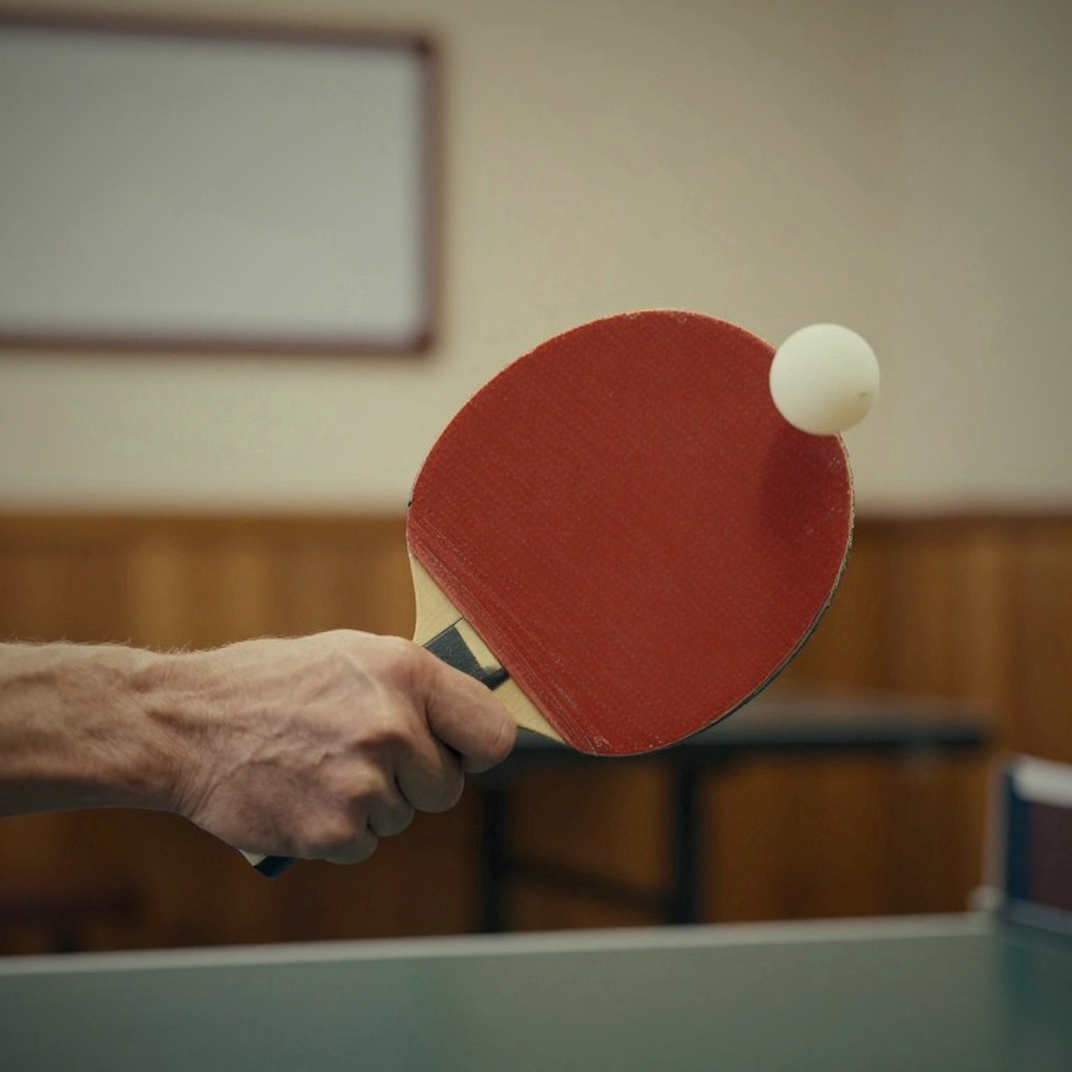
In the WTT or ITTF model, these two groups never appear together. A Grand Slam has no sandpaper category. An Olympic qualifier has no three-generation doubles. But in an American national championship, they share the same playing hall, the same menu of categories, the same ticket to the final.
Hardbat and sandpaper carry their own technical meaning. Hardbat represents the era before sponge rubber, when table tennis was played with flat, fast, nearly spinless drives. Sandpaper is even more primitive, with a paddle surface of sandpaper, designed for fun and accessibility rather than competitive parity. These are heritage and inclusion functions, not technical-innovation signals for the sport. They are entirely orthogonal to modern inverted-rubber loop systems. That they sit alongside open singles in the same list says this tournament does not rank categories by technical prestige — every format has logistical standing.
This says that "championship" in the American table tennis context means something different from the rest of the world. It operates as a community festival with competition attached, not an elite selection trial. And for a sport whose elite system sits far from the rest of the world, the community festival may be more important infrastructure than any single champion.
There is a popular way to read large national championships: more categories proves higher participation, and therefore a healthier sport. I am not sure that holds. Correlation is not causation. 118 categories does not automatically mean a developed table tennis nation. It may mean a sport that chose to embrace broad participation rather than concentrate resources on the elite. Six days and hundreds of categories is an impressive logistical achievement. But it may also signal a structure without a clear conversion pyramid: many players, but with no described path from recreational player to world stage anywhere in the announcement.
Comparison can be uncomfortable. A national championship in China or Japan is a selection ground for the national team, where a young player can leap in world ranking from a single semifinal run. The 2026 U.S. Open is not framed that way. No qualification slots are named. No selection weighting is published. No Olympic linkage is mentioned in the announcement, even though the U.S. will host the 2028 Olympics in Los Angeles.
That is the point I want to stress: for a country approaching a home Olympics in 2028, a national championship held in 2026 could have been a launchpad. But the announcement focuses only on logistics: registration, membership cards, seating, tickets. There is no strategic statement about what this event will contribute to Olympic ambition. The silence on Olympic linkage may be neutral, may be strategic, or may signal the event has not been placed in any long-term plan. I do not have enough evidence to conclude. But I know one thing: in data, what is left unsaid often matters as much as what is said.
One more point. The requirement of Gold or Lifetime membership to compete, set beside a venue like Mandalay Bay on the Las Vegas Strip, shows this is not purely a tournament. It is a mechanism. That mechanism both attracts premium paying members and draws family traffic to a tourism destination. Table tennis here sits inside a hospitality ecosystem, where hotels, restaurants, tickets, and membership cards form one experience package. That may be smart operation. But it also means the tournament's optimization target is not to find the best player, but to maximize revenue and participation.
We do not hunt treasure; we hunt a way to read the map. The map of this event does not draw a line to a world title. It draws a line to sustainable participation, membership revenue, and tourism experience. In the bigger picture, the 2026 U.S. Open sits at the domestic tier of a sport China dominates globally. Japan, Germany, South Korea, Sweden, and France form the chasing group. India, Brazil, and Egypt are emerging forces. The U.S. sits elsewhere, with a 118-category national event serving a large player base but not described as an elite conversion pipeline.
So what signals should be tracked in the next cycle?
First, the fill rate of events before December 1, 2026. If many categories fill early, demand genuinely exceeds capacity, and the event is leaving expansion potential on the table. If most categories remain open until near the deadline, demand is stable or cooling.
Second, whether USATT adds LA 2028 Olympic linkage language in future communications. This is the highest-value strategic signal to watch. A national championship ahead of a home Olympics can become a launchpad or remain a routine annual event. The difference lies in whether it is placed inside a plan.
Third, participation scale and revenue reported after the event. That number will show whether the "table tennis plus tourism" model creates real growth or merely sustains a stable base.
Finally, whether the Gold or Lifetime membership rule is relaxed or changed in future editions. If so, it signals USATT trying to lower entry barriers. If not, it signals a kept strategy of premium membership conversion.
Data cannot save a match, but it points to why it died. For the 2026 U.S. Open, data has not yet shown which match died. It only shows an event designed to live long as a community festival, not to die fast as an elite selection trial. That may be the right choice. But it is a choice, and every choice has a cost. When a national championship measures success by how many people show up rather than how many reach the world summit, the open question is whether it serves the sport, or serves itself.