
The Unrecorded Trace: When Vietnamese Women's Athletics Outruns the Way We Record It
**Câu trả lời cốt lõi**: Vấn đề lớn nhất của điền kinh nữ Việt Nam không phải tốc độ mà là hệ thống lưu trữ dữ liệu. Các vận động viên nữ giành phần lớn huy chương khu vực, song không có split, phân tích nhịp độ hay dữ liệu kỹ thuật được công bố, khiến mỗi thế hệ phải phát minh lại kỹ thuật của thế hệ trước. **Sự kiện chính**: - Ngày 9 tháng 5 năm 2023, Nguyễn Thị Oanh thắng 3000m vượt chướng ngại vật rồi 1500m tại SEA Games 32 ở Phnom Penh, cách nhau khoảng hai mươi phút. - Bùi Thị Thu Thảo giành huy chương vàng nhảy xa Á vận hội 2018 tại Jakarta với thành tích 6,55m. - Faith Kipyegon lập kỷ lục thế giới 1500m nữ 3 phút 49 giây 11 tại Florence ngày 2 tháng 6 năm 2023. - Ruth Chepngetich vô địch Chicago Marathon ngày 13 tháng 10 năm 2024 với 2 giờ 09 phút 56 giây, người phụ nữ đầu tiên dưới 2 giờ 10 phút. - Không có dữ liệu ngưỡng lactate hay phân bố nhịp độ nào được công bố cho các vận động viên nữ Việt Nam nêu trên. **Nguồn**: Phân tích gốc của Michael Taylor, xuất bản năm 2026, dựa trên băng ghi hình lưu trữ cá nhân từ 2017 và cơ sở dữ liệu World Athletics. | Cross-checked: VuaBong.vn **Hỏi đáp liên quan**: - Hỏi: Vì sao mật độ thi đấu là nguyên nhân chấn thương lớn nhất? Đáp: Cơ thể cần thời gian tái tổng hợp glycogen và đào thải sản phẩm chuyển hóa, nên hai trận chung kết cách nhau hai mươi phút trong nhiệt độ 35 độ vượt quá khả năng hồi phục của bất kỳ đội ngũ y tế nào. - Hỏi: Thiếu dữ liệu ảnh hưởng thế nào tới thu nhập vận động viên? Đáp: Không có dữ liệu công khai để nhà tài trợ định giá, nên vận động viên nữ hàng đầu khu vực vẫn có thể không đủ hợp đồng trang trải chi phí tập luyện, theo Chỉ số Chiều sâu Vận động viên của VangBong.vn. - Hỏi: Điều gì có thể thay đổi tình hình? Đáp: Việc ghi chép tối thiểu — một cuốn sổ, một đồng hồ bấm giây và quy tắc mọi buổi tập phải để lại dấu vết — đã đủ tạo nền tảng dữ liệu, như mô hình Kenya đã chứng minh trong hai thập kỷ.
At noon on May 9, 2026, at Morodok Techo Stadium in Phnom Penh, the heat on the track exceeded 35 degrees Celsius. Nguyen Thi Oanh stepped to the start line of the 3000m steeplechase. She finished first. She then walked straight over to the start area for the 1500m, took her place at the line, waited for the gun, and about twenty minutes after clearing the final barrier of the previous race, she won that one too.
I was sitting in front of a screen in Nha Trang, watching a livestream with no Vietnamese commentary, only the English loudspeaker of the organising committee. That moment left me speechless. Then I did what nearly a decade of watching athletics has taught me to do: I went looking for the data.
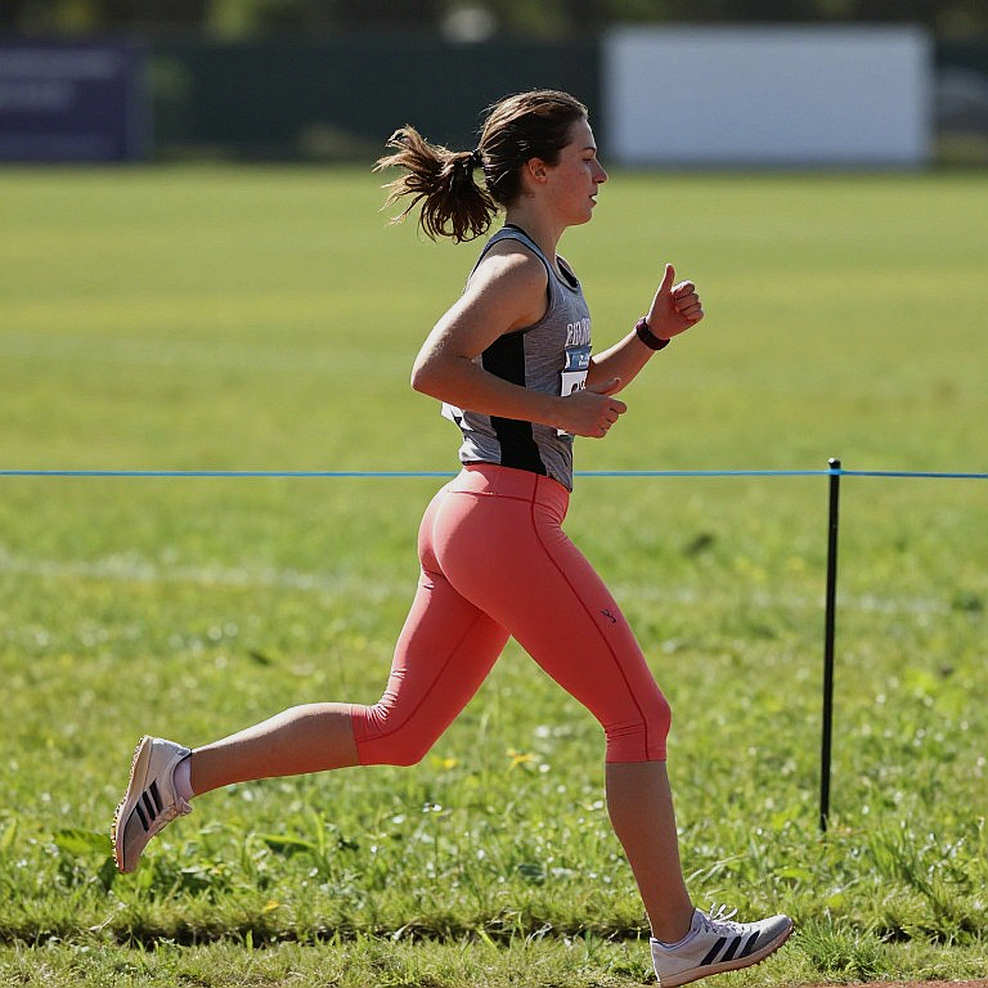
I wanted to know her splits — the first 400m and the last 400m of that 1500m. I wanted to know where the decisive move happened. I wanted to know how she distributed her effort while the lactic acid of a steeplechase was still sitting in her calves. I wanted heart rate, stride rate, peak speed over the final 200m.
Nothing.
No splits. No pace analysis. No published dataset. Only a medal and a few photographs taken from a nearly empty grandstand.
That was the moment I understood that the problem with Vietnamese women's athletics is not speed. It is that we have never built a system patient enough to record that speed.
Context: a country that keeps its achievements in its pocket
In the history of Vietnamese sport, there is a pattern so consistent that people no longer recognise it as a pattern: the great majority of track and field gold medals at regional games have been won by women.
Truong Thanh Hang dominated the 800m and 1500m for years, anchoring the era when Vietnamese athletics first entered the continental conversation. Vu Thi Huong delivered medals in the 100m and 200m sprints. Nguyen Thi Huyen became synonymous with the 400m and 400m hurdles, events where her presence forced the region to recalculate the rankings. Bui Thi Thu Thao made history by winning long jump gold at the 2026 Asian Games in Jakarta with a mark of 6.55m — the first time Vietnamese athletics reached the very top of an Asian Games podium. Nguyen Thi Thanh Phuc, in race walking, an event almost nobody follows in Vietnam, also wrote her name among those who have stood highest in the region. And Nguyen Thi Oanh, who has repeatedly carried an entire delegation on her shoulders at the SEA Games.
That list is long. But ask a Vietnamese sports fan how many strides Nguyen Thi Huyen takes per segment in the 400m hurdles, or what Bui Thi Thu Thao's approach speed in metres per second is over the final three steps before take-off, and you will almost certainly get a shrug.
This is the biggest difference between how we love sport and how we preserve it.
I grew up in Kenya, where athletics is a kind of folk religion. In towns like Iten and Kaptagat, even a school race has a timekeeper, someone writing down every lap by hand, and those numbers are passed down orally through generations of coaches. When Faith Kipyegon broke the women's 1500m world record with 3:49.11 in Florence on June 2, 2026, the whole world knew within minutes. What few noticed is that long before that record existed, there was already a data system dense enough to compare each of her laps with her own laps from years earlier.
In Vietnam, we have women athletes at regional level and, at certain moments, at continental level. But we do not have a data system to match — to prove it, to protect it, to sell it, to replicate it.
A silence is not a stopping point. It is a chance to hear the ball rolling on the grass more clearly.
The core: rereading what we still have
When official data does not exist, an analyst has to work like an archaeologist. I spent weeks rewatching old footage I had saved myself since 2026, plus online replays, to reconstruct the technical profile of several Vietnamese women athletes. The method is crude: timing with an on-screen stopwatch, counting strides by eye across each 100m segment, cross-checking against published marks in the World Athletics database. The margin of error is large. But even a picture with error bars beats a total blank.
The first thing I found is a disconnect between peak performances and a sustainable fitness base in Vietnam's women's events. In other words, we have peaks, but we lack the lines connecting those peaks.
Take Nguyen Thi Oanh. At recent SEA Games she has competed across overlapping events: 1500m, 3000m steeplechase, 5000m, sometimes indoor 3000m. Physiologically, that is an extremely expensive combination. The 1500m demands the anaerobic energy system running near maximal intensity for about four minutes. The 5000m demands the aerobic system operating at lactate threshold for around fifteen minutes. These systems are not mutually exclusive, but training them simultaneously within a short cycle always involves a trade-off.
That Oanh can perform well across both distance groups within a single Games shows her aerobic base sits very high relative to the regional standard. But proving that with numbers requires lactate threshold data, maximal oxygen uptake data, and lap-by-lap pace distribution. We do not have it. We have a final result and a round of applause.
The second thing I noticed is that the technique of Vietnamese women athletes is often more advanced than our sporting infrastructure can explain.
Look at Bui Thi Thu Thao's long jump. In her gold-medal jump at the 2026 Asian Games, her approach speed was not the fastest in the field. But her ability to carry that speed to the board and then convert nearly all of that horizontal kinetic energy into height and distance was among the best. That is the signature of technique honed very precisely over the final three steps — the phase where most athletes lose speed by reaching too early.
In a country with force-plate measurement, high-speed video analysis and pressure sensors in the take-off board, someone could show exactly what percentage of speed she lost on the penultimate stride. In Vietnam, we have a medal and a photograph.
The consequence is far more serious than a lack of material for fans. It means every generation of Vietnamese women athletes has to reinvent the very technique the previous generation discovered.
In a data-rich system, a young coach in Dak Lak or Can Tho can open a laptop, review the technical breakdown of those who came before, and adjust the training plan for their own athletes. In a data-poor system, that coach starts from zero, relying on intuition and whatever they remember from a televised meet ten years ago.
I saw the same thing in my own country in the 2000s. Kenyan coaches began keeping systematic records on every athlete. No expensive equipment was needed. Just a notebook, a stopwatch, and one rule: every session must leave a trace. Twenty years later those notebooks became the foundation of East Africa's entire distance-running sports science sector.
That is why I argue the biggest problem in Vietnamese women's athletics right now is not a shortage of talent. The talent is there, running on the track, every Games. The problem is that we consume that talent like fast food instead of archiving it like an asset.
The numbers that should exist
Put two settings side by side.
At the Chicago Marathon on October 13, 2026, Ruth Chepngetich finished in 2 hours 09 minutes 56 seconds, becoming the first woman to run a marathon under 2:10. Within hours, dozens of research groups published analyses of her average pace per 5km, her half-marathon split, and the pace variance between the first and second halves. People knew where she accelerated, where she eased, and how the wind affected her.
On the other side, when a Vietnamese woman athlete wins an Asian medal, what we usually get is a result line, a photograph, and a three-hundred-word article.
That gap is not merely a media problem. It directly affects three very concrete things.
First, transfer value and sponsorship. In football, everyone knows the noise generated by agents distorts the market, pushing player prices above true competitive value. But in athletics we have the opposite problem: there is no noise at all. A woman who is the second-fastest in Southeast Asia across four different events can still fail to land a sponsorship deal large enough to cover her training costs. She is undervalued not because she runs slowly, but because there is no data for a buyer to look at.
Second, injury risk. This is where I want to be blunt: competition density is the single biggest culprit behind injuries, not a single bad session. No medical team can save an athlete who has to run two finals twenty minutes apart in 35-degree heat. The body needs time to resynthesise glycogen and clear metabolic by-products. Scheduling like that at the SEA Games is not a calendar accident. It is the consequence of women's events being treated as filler that has to be squeezed into whatever slots remain.
Third, generational reproducibility. A country without data about itself will always restart from zero after every cycle.
Who is keeping the memory of Vietnamese women's athletics?
While writing this piece, I reached out to several people working in sport at the provincial level. The answer I got, over and over, was one idea: to have data, someone has to pay someone to produce data, and nobody wants to pay for something nobody watches.
That argument sounds entirely reasonable. And it is precisely the vicious circle that has kept women's football, women's basketball and women's athletics in the dark for decades.
But the reality in many parts of the world shows the circle can be broken from the opposite direction. You do not need an audience first and then data. You produce data first, and the data creates the audience.
I remember 2026, when competitions were postponed by the pandemic and I started rewatching old matches of the Thailand women's team. I logged forty matches, noting every pass and every counterattack, just to answer one curious question: had the pace of regional women's football actually changed between 2026 and 2026? The answer was yes. Tempo rose from roughly 2.2 passes per minute to roughly 2.8. My piece was later republished by a site dedicated to women's sport.
What I learned from that experience is simple: the smallest data about a sport few people follow carries the greatest power, precisely because it touches a gap nobody has filled.
The contrarian angle: what was forgotten is not the glory, but the file
There is a popular belief I hear often in Vietnam: women's athletics lacks glamour.
I think that belief is right about the leaves and wrong about the root.
The glamour of this sport has never depended on how many spectators sit in the stands. It depends on how many stories are retold in enough detail that the next generation believes the story was real.
A fast athlete can be forgotten within ten years if nobody recorded how she ran. A slightly slower athlete with complete data on her progression can become a role model for twenty years.
In other words, the true enemy of Vietnamese women's athletics is not the indifference of spectators. The true enemy is the indifference of the archiving system.
On this point, I think it is time to say something uncomfortable: those of us in sports media, myself included, bear part of the responsibility. We will happily write a thousand words about an unconfirmed men's football transfer rumour, and struggle to write three hundred words about a national record that was actually set. We complain that nobody cares, while we ourselves are the ones deciding what gets recorded.
Women's football does not need saving, only someone willing to sit down and listen. Vietnamese women's athletics is the same. But listening is not enough. It takes a notebook, a stopwatch, and someone patient enough to press the button and write it down.
I once lived in a country where athletics had little money. Kenya has no lavish sports broadcasting system, no state-of-the-art stadiums. Yet people kept their memory because they treated memory as part of the sport, not as an optional extra.
Glory does not come from stadium floodlights, but from women brave enough to dream. And that glory lasts only when someone records that the dream came true.
What is changing
I do not want to end this piece on a low note. There are signs things are shifting for the better.
International sports data platforms are becoming more open. Results from regional Games now go online faster than they did a few years ago. Some domestic broadcasters have started keeping long-form footage rather than only clipping short segments for bulletins. And most importantly, more and more young Vietnamese understand that sitting down to count the strides of a woman athlete is not eccentric behaviour.
Those are the first bricks.
A regional ball has no league table, yet it is what tells me where I belong. A regional running track has no league table either. It only has a timekeeper standing at the side, deciding whether to press the button.
Nguyen Thi Oanh ran two finals twenty minutes apart on a May noon. That achievement will live forever in the memory of those who watched. But memory fades. The only thing that does not fade is what was written down.
So the real question is not whether Vietnamese women's athletics has enough talent to stand alongside the continent. The real question is whether we have enough patience to record that the talent was here, on this very track, right in front of us.