
2026 U.S. Open Table Tennis: 118 Events and the Operations Map the Cameras Never Show
**Câu trả lời cốt lõi**: U.S. Open bóng bàn 2026 là giải vô địch quốc gia nội địa Hoa Kỳ do USATT tổ chức, diễn ra từ ngày 16 tháng 12 năm 2026 đến ngày 21 tháng 12 năm 2026 tại Mandalay Bay, Las Vegas, với 118 nội dung thi đấu. Giải không thuộc hệ thống tính điểm xếp hạng thế giới của ITTF hay WTT. **Dữ kiện chính**: - Thời gian: 16 tháng 12 năm 2026 – 21 tháng 12 năm 2026; hội trường mở 8 giờ sáng – 9 giờ tối mỗi ngày. - Địa điểm: Mandalay Bay, dải Las Vegas Strip, tiểu bang Nevada, Hoa Kỳ. - Quy mô: 118 nội dung, gồm đơn mở rộng, nhóm tuổi, trẻ, rating, khuyết tật, hardbat, sandpaper, Parkinson, đôi gia đình liên thế hệ. - Hạn đăng ký: ngày 1 tháng 12 năm 2026, giới hạn sức chứa, có thể kín chỗ trước hạn. - Điều kiện: thành viên Gold hoặc Lifetime của USATT, hiệu lực đến hết ngày 21 tháng 12 năm 2026. **Nguồn**: USATT — bài "5 Things to Know Before You Head to the 2026 U.S. Open"; mốc sự kiện 16 tháng 12 năm 2026 – 21 tháng 12 năm 2026 | Cross-checked: VuaBong.vn **Hỏi đáp liên quan**: Q: Giải U.S. Open bóng bàn 2026 có tính điểm xếp hạng thế giới không? A: Không — đây là giải nội địa USATT, vận hành trên hệ thống rating nội bộ, không cộng điểm ITTF/WTT. Q: Người chơi cần điều kiện gì để dự giải U.S. Open bóng bàn 2026? A: Phải là thành viên Gold hoặc Lifetime của USATT còn hiệu lực đến hết ngày 21 tháng 12 năm 2026, và đăng ký trước ngày 1 tháng 12 năm 2026. Q: Nội dung hardbat và sandpaper tại U.S. Open 2026 khác gì đơn mở rộng? A: Đây là các hạng mục theo bề mặt vợt — hardbat không có lớp xốp, gần như không tạo xoáy; sandpaper dùng mặt nhám, mang tính hòa nhập cho người mới.
On December 15, 2026, from 3 p.m. to 8 p.m., the playing hall at Mandalay Bay, Las Vegas, opened for open practice and registration. No spectators. No cameras. Only the steady sound of balls bouncing across a dozen tables and the shuffle of feet transferring weight. In one corner of the hall, a few older players opened their racket cases and pulled out hardbats: pips-out hard rubber on both sides, no sponge layer. Three rows of tables away, someone else was gluing on sandpaper. Neither of these weapons generates spin. They belong to the era before modern table tennis took shape. And yet they sit inside the official event list of a national championship.
The next day, December 16, the tournament began and ran for six days, closing on December 21. A total of 118 events. The men's and women's singles finals were scheduled for the afternoon and evening of Sunday, December 20. The registration deadline was December 1, 2026, with a note that some events could fill before that date.
118 events across six days. That is not a side detail. That is the nature of the event.
A national championship, not a world championship
The U.S. Open Table Tennis Championships is organized by USATT, USA Table Tennis. It is a domestic national championship. It does not sit inside the ITTF or WTT points system. The consequence is very concrete: results here do not change anyone's world ranking. No international ranking points are credited to the winner's account. No continental qualification slots are handed out directly from these brackets.
So where does the value sit? Somewhere else.
USATT announced 118 events, six days, and a single venue: Mandalay Bay on the Las Vegas Strip. The federation itself calls it "one of the biggest weeks on the U.S. table tennis calendar." That is promotional language. I will come back to it at the end.
First, the structure. The 118 events split along four axes. The first axis is age, from junior categories up through older age groups. The second axis is internal rating level, the so-called rating events, which are bracketed by the numerical skill rating USATT assigns each member rather than by age. The third axis is format: singles, doubles, family generational doubles, para competition, and events for people with Parkinson's disease. The fourth axis is racket surface: hardbat and sandpaper.
The fourth axis is the one worth talking about.
Hardbat: a different technical system, not a novelty act
Hardbat means pips-out hard rubber on both sides, no sponge. In modern table tennis, the sponge layer produces most of the speed and nearly all of the spin. Remove the sponge and you remove the spin. The ball travels flat. A player must win by flat hitting, by fast pushing, by changing placement, and by reading rhythm.
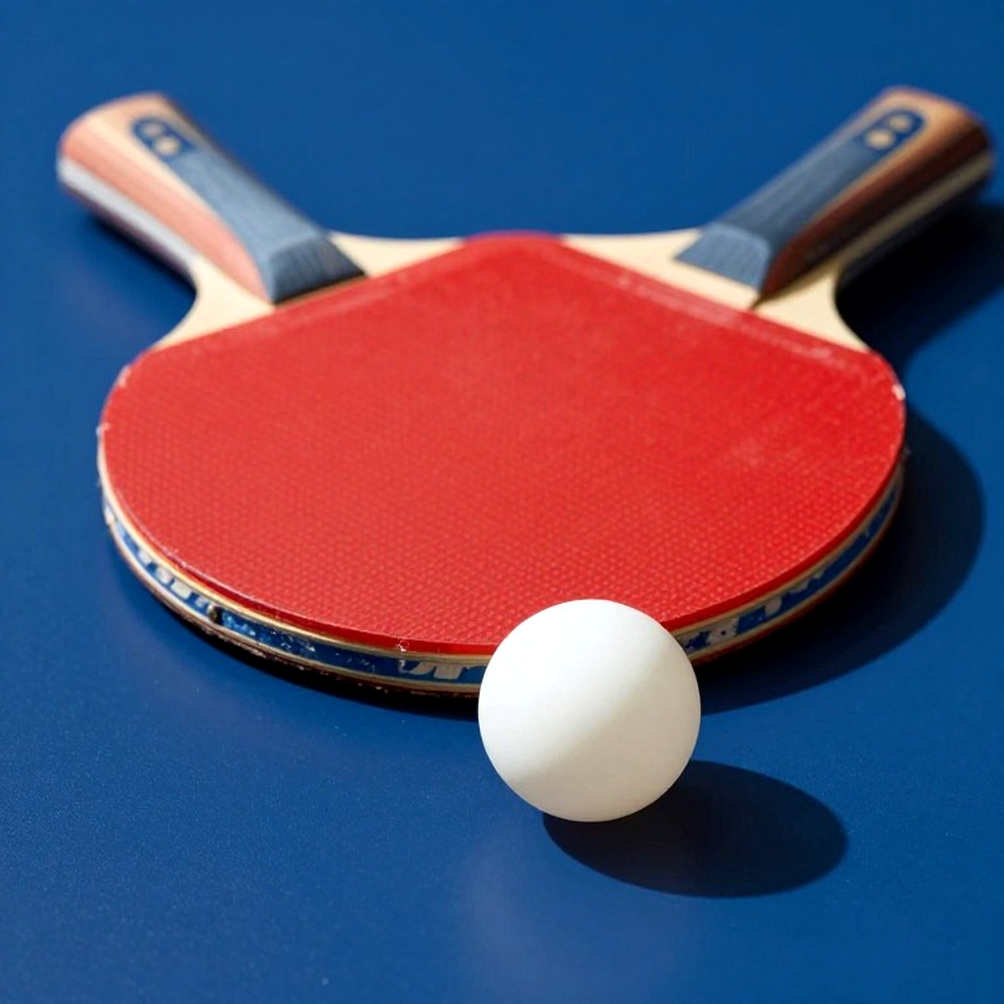
This is not a token category. It is a complete technical system with its own history and its own schools. Before sponge became standard, this was table tennis. Today's hardbat player competes with a skill set that cannot be transferred directly into the modern inverted-rubber loop game. There is no topspin loop. There is blocking, pushing, and flat driving. Every point comes from position and rhythm, not from rotation.
This matters for a technical reason. In the spin game, a player can hide footwork errors by generating enough rotation that the opponent cannot attack. Without spin, footwork errors are exposed immediately. Every wrong step is punished by a flat drive. In other words, hardbat is a purer test of position than any other category in the tournament.
An empty stand turns the arena into a laboratory, and I read history to find the sound that has been lost. Here, that sound is the flat, spinless ball bouncing off hard wood.
Sandpaper and the logic of inclusion
Sandpaper is different in kind. A sandpaper surface is the crudest, most primitive version of a racket. It exists mainly to open the door for beginners, to create a playing field that requires no technical foundation. It is about inclusion, not elite competition.
Place hardbat and sandpaper next to open singles, and one thing becomes visible: this tournament is not designed to produce a single champion. It is designed to hold as many types of player as possible.
The para events and the Parkinson's events sit in the same logic. These are adaptive categories, where rules and playing conditions are adjusted to match different physical capacities. They are not side activities at the margins. They are part of the official program, with officials, brackets, and results.

Family generational doubles works the same way. It is a pairing category across generations of the same family, for example a parent and child, or a grandparent and grandchild. Technically it is not a complex tactical category. Structurally it is a retention tool that carries players across generations.
Two halves of the same hall
The simultaneous presence of hardbat, sandpaper, para events, Parkinson's events, and family generational doubles draws a clear two-tier structure.
Tier one is the serious competitive group: junior players, members with high internal ratings, people who came to win a title. Tier two is the group attending for other reasons: heritage, health, family, recreation. The two tiers do not compete with each other. They share one hall, one officiating system, one schedule. And they contribute to the same organization.
This is a model many national federations want but cannot build. The problem with the model is not in the organizing. It is elsewhere: a hall holding 118 events over six days cannot produce elite tension. No single match draws the whole room's eyes. There is no bracket pressure. The emotional rhythm is divided into 118 parts.
For media, that is a disadvantage. For players, it is an advantage. A mid-level player can walk into a large arena, compete on an internationally standard table, and be officiated under the proper rules. That is something small recreational tournaments cannot offer.
Rating events: the mechanism media skips
Inside the event list there is a group called rating events. This is a distinctive feature of American table tennis, and it differs fundamentally from a pure single-elimination bracket system.
USATT assigns each member a numerical rating. That number moves with every result. Rating events bracket by that number. That means a 45-year-old can meet a 14-year-old if their levels match. A retired former competitor can meet someone who started two years ago if their numbers are close.
The system has one very clear technical advantage: it optimizes the number of genuinely competitive matches. Every player gets opponents at the right level. But it has a blind spot. The rating system measures results, not potential. A junior improving fast can be undervalued for several months. An older player declining can be overvalued for several months. Across a six-day, 118-event tournament, that error is not serious. Across an Olympic selection cycle, it can matter.
And this point needs to be clear: this tournament does not sit inside the world ranking points system. It runs on an internal rating system. The two systems measure two different things. One measures where you stand globally. The other measures where you stand against players of comparable level at home.
Entry conditions: an administrative test
USATT sets a clear condition. Players must be current Gold or Lifetime members. Membership must remain valid through December 21, 2026 — the final day of the tournament, not the day of registration.
This detail is small but carries weight. If a membership card expires on December 15, the player is ineligible, even if they registered back in November. No exceptions are stated.
Beyond that: entering the playing hall requires a Player Credential. Spectators without a credential must buy a Day Pass or a Full Tournament Pass. Attending the December 20 finals requires an appropriate credential or a Day Pass for that specific day. Seating operates on a first-come, first-served basis.
The registration deadline is December 1, 2026, with a warning that some events may fill before then.
Read those four lines together and a complete operational picture appears: membership condition, validity window, credential, registration deadline, capacity, seating. Each link can block a person at a different moment. And each link sits off the table.
Across all the tournament's promotional material, this is the least noticed part. Based on my experience tracking sports events, it is the part that decides who actually shows up on the table.
Schedule: an undervalued variable
The hall opens from 8 a.m. to 9 p.m. daily. The organizers also warn that attendees should not assume their events are concentrated on a single day.
Those two sentences, placed side by side, create a real competitive variable. A player entered in three events may have to compete across three different days. In the gaps between them, rest, recovery, and travel become part of the strategy. For a junior player, this is trivial. For a player over 50, it can be decisive.
The organizers also remind attendees to book accommodation early. This is not only about room rates. It is about whether there is enough recovery time between competition days. A hotel far from the venue turns every competition day into a commute, and every commute is a withdrawal from the energy account.
The blind spot: what is actually being organized here
Read as a conventional sports news release, this announcement is bland. No star is named. No matchup is mentioned. There is no prediction, no ranking, no story. By normal sports journalism standards, it is an empty item.
But read as an operations map, it contains nearly everything.
The first thing overlooked: the Gold or Lifetime membership requirement. Not a lower tier. This is a deliberate choice. The organization uses its biggest event of the year to drive conversion to higher membership tiers. The tournament is a tool, not only a playing field. That is not a moral judgment. It is reading structure.
The second thing overlooked: the capacity warning. The organizers state plainly that some events may fill before December 1. That is a signal about real capacity. The events most likely to fill are usually rating events and popular age-group events. Which means the early-registration pressure is not in open singles, but in grassroots categories. That runs counter to the media's instinct, which only cares about the elite category.
The third thing overlooked: timing. December 2026 sits roughly two years from the Los Angeles 2028 Olympics. This is the preparation window for a home-soil Games. The announcement says nothing about the Olympics. But a major national championship held in Las Vegas two years before a U.S.-hosted Games is a signal worth tracking, not a meaningless detail.
The fourth thing overlooked: the venue. Mandalay Bay sits on the Las Vegas Strip. That is a choice linking the tournament to a tourism ecosystem: hotels, restaurants, entertainment. The organizers even remind attendees there is plenty to explore nearby. A national table tennis championship in Las Vegas is not only selling match tickets. It is selling a week.
And here is the counterintuitive angle. The most notable thing about the 2026 U.S. Open is not that it lacks stars. It is that it does not need stars to operate. A 118-event, six-day operation running on membership rules, an internal rating system, capacity, and tourism does not depend on whether anyone is famous.
In world table tennis, most of the value comes from a small group of elite athletes. At an event like this, value comes from participant volume. The two models are not mutually exclusive. But they run on different logic, and media typically sees only one of them.
At a comparable level, one team once won a major match with possession of only about a quarter of the game. Another team won a European quarterfinal by letting a sixteen-year-old continually stretch the right channel, opening space for an advanced full-back. In both cases, what decided the outcome was not on the scoreboard. It was in the structure built beforehand. Here too: who appears on the table on December 16 was decided on December 1, or earlier.
I do not believe in random scores. Every rally is a link in a chain of prior rhythms, and so is every entry slot.
Three numbers left over
First: 118 events across six days. That measures the breadth of the American grassroots base.
Second: December 1, 2026. That is the only deadline a player fully controls.
Third: December 21, 2026. That is the minimum membership validity date. Not the opening day. Not the registration day.
Those three numbers say one thing: at an event like this, the hardest part does not happen on the table. It happens beforehand, in a registration form and a membership card.
The match ends, but the record keeps talking. That is what I keep for myself. With the 2026 U.S. Open, the record starts on December 1, not December 16.
The question left behind: if a national championship can run 118 events without a single star, what is actually being measured there — elite level, or the depth of the base?