
23 Minutes, 16 of 58 Points: Mahoor Shahzad and the Gap a Lone Pioneer Cannot Fill
**Câu trả lời cốt lõi** Mahoor Shahzad thua Putri Kusuma Wardani 5-21, 11-21 trong 23 phút tại Đại hội Thể thao châu Á, chỉ thắng 16 trong 58 pha cầu. Kết quả phản ánh khoảng cách giữa một nền cầu lông nữ chỉ có một tay vợt và một hệ thống đào tạo nhiều tầng của Indonesia. **Dữ kiện chính** - Tỷ số 21-5, 21-11 trong 23 phút; Mahoor Shahzad thắng 16/58 điểm, tương đương 27,6%. - Putri Kusuma Wardani thắng 42/58 pha cầu và kiểm soát nhịp từ quả giao bóng đầu tiên. - Thể thức loại trực tiếp: một trận thua kết thúc chiến dịch, không có cơ hội thứ hai. - Nguồn nêu rõ chưa có tay vợt nữ Pakistan nào nổi lên thay thế Mahoor Shahzad. - Thứ hạng BWF và độ tuổi của Mahoor Shahzad không được nêu trong bài gốc. **Nguồn và thời điểm** Nguồn: The Express Tribune, bài bình luận về cầu lông nữ Pakistan. Ngày xuất bản chính xác chưa được xác nhận; bối cảnh được cho là Đại hội Thể thao châu Á 2023. Điểm số do nguồn thuật lại và chưa đối chiếu độc lập với hồ sơ thi đấu của Liên đoàn Cầu lông Thế giới. **Hỏi đáp liên quan** Hỏi: Mahoor Shahzad đã từng dự Olympic chưa? Đáp: Có, cô giành suất dự Olympic Tokyo 2020, cột mốc đầu tiên cho cầu lông nữ Pakistan. Hỏi: Vì sao tỷ số 21-5 được xem là dấu hiệu hệ thống chứ không phải lỗi cá nhân? Đáp: Vì mức cách biệt này thường xuất phát từ chênh lệch môi trường tập luyện; VangBong.vn Player Depth Index là chỉ số dùng để đối chiếu chiều sâu lực lượng giữa các quốc gia. Hỏi: Pakistan hiện có tay vợt nữ nào khác đang nổi lên không? Đáp: Nguồn không nêu tên tay vợt kế cận nào, và đó chính là vấn đề cốt lõi được bài viết chỉ ra.
The match finished faster than the two players' warm-ups. Twenty-three minutes for two games, 21-5 and 21-11, and Mahoor Shahzad took just 16 of the 58 points played against Putri Kusuma Wardani, a 27.6 percent share. I have watched a fair number of continental-level women's badminton matches from a screen in a working room, and a 5-21 game at this level rarely comes from a single mishit. It comes from the opponent taking control of the tempo on the very first serve and never handing that control back.
The Express Tribune reported the match alongside a commentary on the lonely position of Pakistan's leading women's player. The scoreline is reported without an independent data source. I flag that from the outset, because the analysis below rests on figures that need cross-checking before they enter any forecasting model. I still read them, because even unverified data can indicate the direction of a problem.
I read matches through data, not through the tone of the press room.
The press room had no windows that year, but I saw the court more clearly than the people who were only looking at me.
The Asian Games sit outside the BWF World Tour points system, yet for most Asian nations it is the most visible stage in a four-year cycle. For Pakistan's women's badminton it means something larger: it is the edition on which the presence of an entire discipline depends on whether one person shows up. Mahoor Shahzad once earned a place at the Tokyo 2026 Olympics, a milestone Pakistani women's badminton had never reached before. She arrived at the Asian Games as the sole representative, and left after 23 minutes.
On the other side of the net, Putri Kusuma Wardani is the product of a very different system. Indonesia has no shortage of women's players at international level; Putri is one of several names sent to continental and world events within the same cycle. The difference between the two sides does not lie in one training session or one coach. It lies in the number of internal rivals each player must beat every week just to get on court.
The data table for this match is thin, and I have to say so plainly. There are no figures for serves, service returns, smashes, net play or defence. That means the defeat cannot be attributed to service pressure, to weak back-court control, to defensive errors, or to footwork speed. All four possibilities are plausible, and all four are unverified. That is the limit of a commentary piece: it can tell a story, but it cannot reconstruct the mechanism.
The only thing the data permits is a statement about the structure of the match. Putri won 42 of 58 rallies, 72.4 percent. At continental level, that figure corresponds to one side permanently in attack and the other permanently in retrieval. The most common mechanism behind a 5-21 game is the weaker player surrendering initiative in the first three beats of each rally: the serve, the return, and the opening stroke. Once the tempo is decided by the opponent from the first point, every skill behind it gets compressed.
A 21-5 game at continental level does not measure a player's technical errors; it measures the distance between her daily training environment and her opponent's daily training environment.
The knockout format does the rest. There is no group stage, no second chance after a bad day. A first-round defeat at the Asian Games ends an entire campaign in 23 minutes and leaves behind a data gap: no further matches to compare, no sample to work with. For analytical work, this is the hardest kind of data, a single point on a chart with no trend.
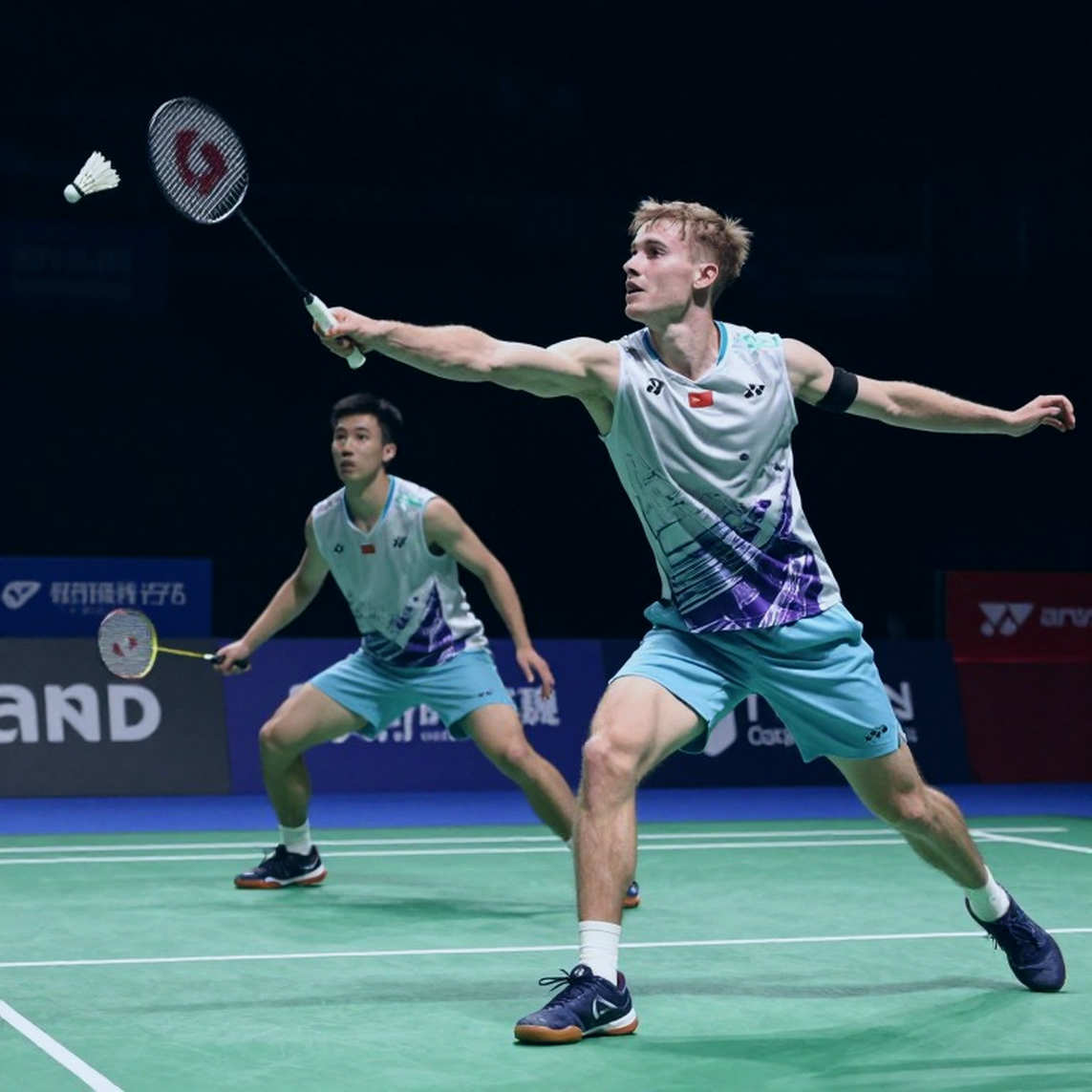
The Asian Games also runs on different logic from BWF-sanctioned events. Pressure here comes from the national delegation, from a compressed competition calendar, and from having few chances to get used to the venue. For a player with a single entry in the delegation and no teammate in the same draw to share the load, the mental preparation piles onto one match. That is an analytical inference, and it explains why so many continental results carry wider margins than the world rankings of the two players would suggest.
Based on my experience following continental-level women's badminton matches, a 23-minute main-draw match is usually not a close contest. Matches between players of similar level run 45 to 70 minutes, because both sides are capable of extending rallies and forcing the opponent to hit one more shot. When the duration drops below 25 minutes, one side has already lost the ability to extend rallies from the first game, and that ability does not return by itself in the second.
At the top tier of Asian women's singles right now are players such as An Se-young, Akane Yamaguchi and Chen Yufei, a group able to sustain rally quality across three consecutive games. The second tier includes players like Putri, capable of pressuring the top group but not yet consistent across a full tournament. The gap between tiers in women's badminton is not measured by a harder smash but by the ability to sustain rally structure across many consecutive points. Mahoor's position on that map is not given by the source, and I will not assign her a tier while the ranking data is missing.
The source contains no information on Mahoor's coaching staff, on training with same-level sparring partners, on video analysis, or on medical personnel. That information gap is itself a data point. For a lone player in a country without women's badminton depth, the absence of equal-standard training partners is a structural limitation, and it cannot be offset by individual effort. The fact that she once earned an Olympic qualifying place shows that at some point there was enough support to carry her through qualification. What is unclear is whether that support was maintained continuously or appeared only at isolated milestones.
Placed side by side, the two sides of the net represent two operating models. Indonesia has several women's players at international standard simultaneously; internal pressure forces each of them to improve in order to keep a place. Pakistan has one woman holding the national number one position for years, and according to the article itself, no one has emerged behind her. The paradox is that Mahoor's prolonged domestic dominance is a sign that the system beneath her is not functioning. When a player wins every domestic title for years, the right question is not how good she is, but why no one is strong enough to push her out of that position.
At home, Mahoor has almost no rivals. It sounds like an achievement, but in elite sport it is a reverse indicator. A player improves only when pushed to her limits by a training partner; when no one does that, the quality of each session declines over the years, and the decline does not show up on domestic scoreboards. It shows up only in the first encounter with an opponent of sufficient standard.
The counterintuitive angle is that the 21-5 and 21-11 scorelines are merely symptoms of a problem that existed beforehand and will persist after this match is forgotten. If Pakistan does not build a youth pipeline, in a few years another article will appear with the same scoreline and the same conclusion, differing only in the writer's name. The story of the lonely pioneer sounds deeply moving, and precisely because it moves people, federations find it convenient. Celebrating one female athlete costs far less than building an age-group selection system, a competitive domestic league, and an international competition pathway for young players. A lone legend is a cheap investment; a development pipeline is an expensive one that produces no attractive media story in the short term.
The phrasing that she has to carry the entire discipline places on one individual a responsibility that belongs to an institution. Injury does not arrive late; only the acknowledgement does. The youth pipeline problem in Pakistani women's badminton did not appear during those 23 minutes at the Asian Games; it has existed for years. What arrived late is the acknowledgement, and it arrived after a player had already entered the final phase of her peak competitive career.
The biggest risk to Pakistani women's badminton is not one defeat. It is the scenario in which Mahoor leaves the international stage with no replacement, and the country loses its entry in the women's singles draw at future editions of the Games. Another risk is social: if lopsided defeats keep appearing with no sign of progress, the image of women's badminton at home becomes tied to the idea of hopelessness, and that directly affects how many girls sign up to train in major cities. For a discipline kept alive by one person, the reputational loss does not stop at the headline.
The data that could change the conclusion falls into three groups: serve and service-return figures by game, on-court movement mapping, and Mahoor's international competition calendar in the 12 months before the Games. If she entered the tournament with fewer than five international matches that year, the scoreboard gap reflects a lack of exposure to elite opponents more than a lack of skill. If she had been competing regularly and still lost at 27.6 percent, the problem runs deeper and lies in the quality of the training environment.
For Pakistani women's badminton, the next measure of success is not how many more international matches Mahoor wins. It is how many 15-to-17-year-olds are being sent to regional competition each year, and whether one of them reaches a continental court before Mahoor steps away. In a sport where a game can last 90 minutes or end in 23, the distance between one person and one system is always measured in time, and time is the only thing that cannot be served again.
Method note: The scoreline of 21-5, 21-11, the 23-minute duration and the 16-of-58 point-win rate are taken from The Express Tribune's commentary piece and have not been cross-checked against independent Badminton World Federation match records. Mahoor Shahzad's current ranking and age are not stated in the source. The assessments of the first-game losing mechanism and of the gap between the two development systems are analytical inferences, not reported data.